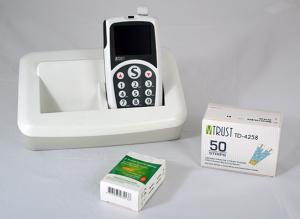
An ICU study evaluated the effectiveness of blood ketone testing versus urine ketone testing for DKA patients. The blood ketone testing group of patients left the ICU 6.5 hours earlier than the urine ketone testing group. This led to savings of 22 hours of nursing time and 375 laboratory investigations, for a total savings of €2,940. * A second study of DKA patients compared a DKA therapy endpoint of pH > 7.3 and blood ketones < 1.0 mmol/L, versus an endpoint of pH > 7.3 and negative urine ketones. The pH/ blood ketone endpoint was reached after 17 hours, whereas the pH/urine ketone endpoint was not reached until 28 hours after starting treatment. The mean lag between the blood ketone and urine ketone groups was 11 hours, ranging from 1 to 36 hours.
** Blood betahydroxyburyrate testing indicates the patient’s status at the time of the test, whereas urine may have been in the bladder for several hours. Urine testing can also produce false positive or negative results due to highly colored urine, highly acidic urine, exposure of the urine test strips to air for prolonged periods, drugs such as the ACE inhibitor captopril, or high doses of vitamin C. Blood ketone
is more accurate than urine ketone testing.
* Vanelli et al. (2003). Cost effectiveness of the direct measurement of 3-β-hydroxybutyrate in the management of diabetic ketoacidosis
in children [Letter to the editor]. Diabetes Care, 26(3), 959.
** Noyes et al. (2007). Hydroxybutyrate near-patient testing to evaluate a new end-point for intravenous insulin therapy in the treatment
of diabetic ketoacidosis in children. Pediatric Diabetes, 8, 150-156.
%20TD-4258E_WIFI_0.jpg)